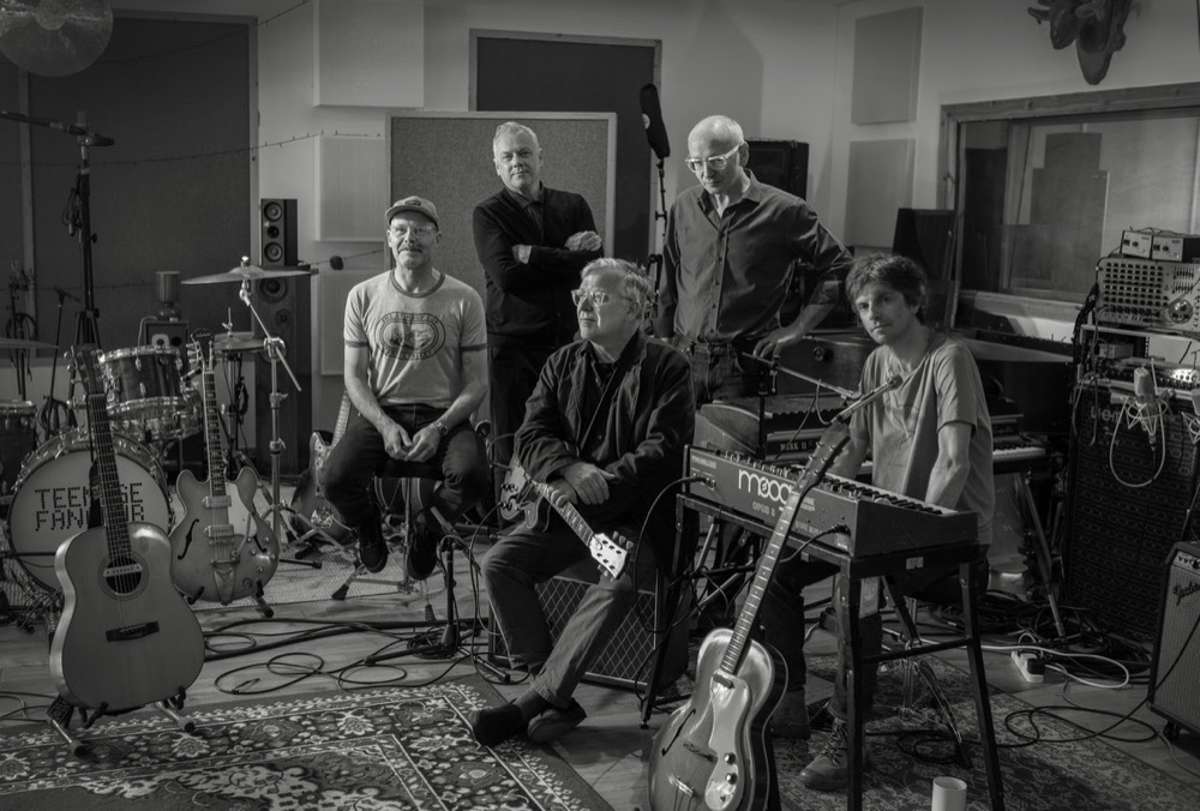
Norman Blake and Raymond McGinley have been making music together in Teenage Fanclub for 37 years, and while some parts of being in a band have gotten easier with time, the simplest things can still trip them up. According to Blake, “It’s difficult when it comes to, y’know, coming up with a name for an album. Especially after you’ve made 12 of them.”
Teenage Fanclub’s 13th album Do Not Dare To Dream — out October 9, 2026 on Merge Records — takes its name from one of Blake’s songs on the record, “I Do Not Dare To Dream,” an infectious anthemic song driven by ringing acoustic guitars, joined at the end by duelling electric guitars that wrap around each other like a reassuring hug. Blake says that the title is meant to mock those memes that urge people to “dare to dream,” which to him are “kind of ridiculous… I don’t think the world works that way.”
And yet, just like the song that inspired its name, Do Not Dare To Dream is in no way a gloomy or pessimistic record. Like 2023’s Nothing Lasts Forever, Teenage Fanclub’s 13th album is full of songs that are calmly resolute, taking stock of the fraught state of the world without succumbing to despair. “I Do Not Dare To Dream” describes how it feels when hopelessness becomes a habit, but it does so in a way that offers comfort. Blake’s warm, organ-washed midtempo ballad “Day In The Sun” and McGinley’s “Over And Over” (a haunting and hypnotic song that evokes the harmonies of songs and hymns from centuries ago) both speak to how everyone can find a renewed sense of purpose by opening their hearts.
Raymond: “We can still be cheerful and optimistic in the face of things not being great, you know? My parents’ generation lived in Glasgow when there were bombs falling out of the sky. And here we are, however many years later. Things change.”
Blake says that just like his “Day In The Sun,” the album-opener “There Was You” (a classic “I was lost but now I’m found” song, setting the tone for the album with its relaxed rhythm and singalong melody) and “Be With You Tonight” (a store of musical treasures, with its rippling piano, Mellotron strings and fuzzy dual-guitar instrumental break) were inspired by some positive personal developments, including moving to a new house in the countryside near Glasgow and beginning a new relationship.
Norman: “I’m in a better place now in terms of happiness and wellbeing, and my songs on this album are really just a reflection of that. I’ve found that the easiest thing to write about is yourself. It can be quite cathartic. It’s sort of like doing your own therapy.”
A similar sense of brightness illuminates McGinley’s “Tomorrow People,” a song which — almost by accident — takes its name from a 1970s British science-fiction series.
Raymond: “There was a whiteboard in the studio, so we started writing song titles on it. Made up, stupid titles. I don’t know how it started, but the titles were based on TV series from the ’70s and ’80s, and one of those was ‘Tomorrow People.’ I couldn’t even remember what the TV series was like, but I started thinking about ‘Tomorrow People’ as a concept, and I think I started singing, as a guide vocal, some joke thing about ‘Tomorrow People’ in the outro section, something I was making up in the moment.