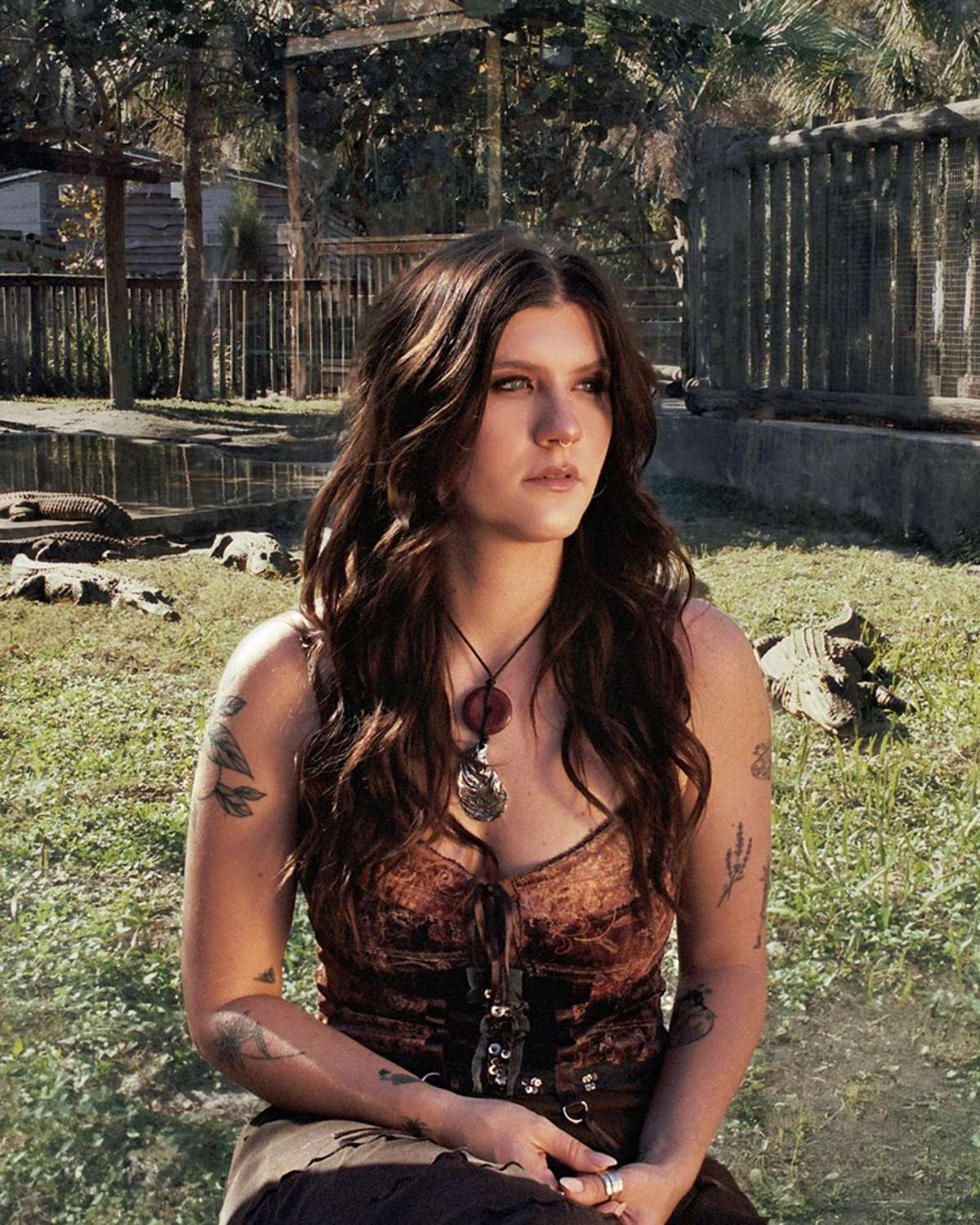
Even when you try to outrun it, the past has a way of slithering out of the shadows and coiling up over your shoulders. Gatlin Thornton had long since left behind the conservative, religious upbringing in the American south and was living her life on her own terms as a young queer woman—but then there it was, inescapable. In combing through old memories, Gatlin unlocked something in her creative process. She had been writing and releasing music since high school, but actually wading through time and re-experiencing all those strong feelings helped catalyze what would become her debut album as Gatlin, The Eldest Daughter (due October TK). The result is a set of songs about rejecting the path laid at your feet and needing to build your own way forward, a record that both embraces nostalgia and knows its inherent pain.
Gatlin spent her early years in Florida, fully entrenched in her conservative Christian private schooling—but her parents encouraged music as an outlet, where she excelled in guitar, piano, and singing. When it came time to start college, Gatlin had already begun bristling at the strictures of her upbringing and questioning how her burgeoning queer feelings would impact that life. She struck out to study songwriting, but after two years instead decided to drop out and work full-time in the heart of the music industry—first for a stint in Nashville, and then relocating to her current home in Los Angeles, while adding in frequent trips to London to collaborate with songwriters and producers.
It was while packing for one of her trips to London when the past first caught up with Gatlin via an old journal she’d stumbled upon. In one entry, she detailed her first realization that she was having feelings for a girl: “If she was a boy I’d be in love.” Gatlin had been amassing tracks full of clever lyricism and grand emotionality inspired by her new life, but that elegantly simple phrase brought a new depth and intensity to Gatlin’s songwriting on lead single “If She Was a Boy.” Not only was she able to recapture some of the most intense memories and feelings of her life, but to also then take those forward and see her fulfilled present and hopeful future in a whole new light.
Co-written with Chloe Kraemer and Amanda Cy, the track opens on a shimmering rhythm section and a slinky synth progression, Gatlin quickly pulls her youthful self forward—the naive lines delivered with a healthy dose of sensual romance. “I’m too afraid of what you think and who’s above/ But if she was a boy/ I’d be in love/ I’d be in love,” she sings, the song recounting a time of tragic distance from one’s heart but also somehow dizzy with potential. “Writing this song in a room in the middle of London with two other queer women was incredible,” Gatlin explains. “It’s not often I’ve gotten to make a track with all women, and I’m addicted to that energy.”
The Eldest Daughter brims with contributions from other talented women, including Jennifer Decilveo (writer and producer for the likes of Miley Cyrus, Lucius, and Hozier), singer-songwriter Liza Owen, and indie rocker Tessa Mouzourakis of English duo Tommy Lefroy. But at its core the album is truly a statement of Gatlin carving her own path and taking control of her narrative, both musically and philosophically.